← All Wonders

The CN Tower

The CN Tower stands taller than every skyscraper in Toronto as the sunset paints the sky.
🗼
Toronto, Canada

The CN Tower

The concrete needle that out-grew every skyscraper on Earth — and held the world record for 32 years!

Scroll to Begin

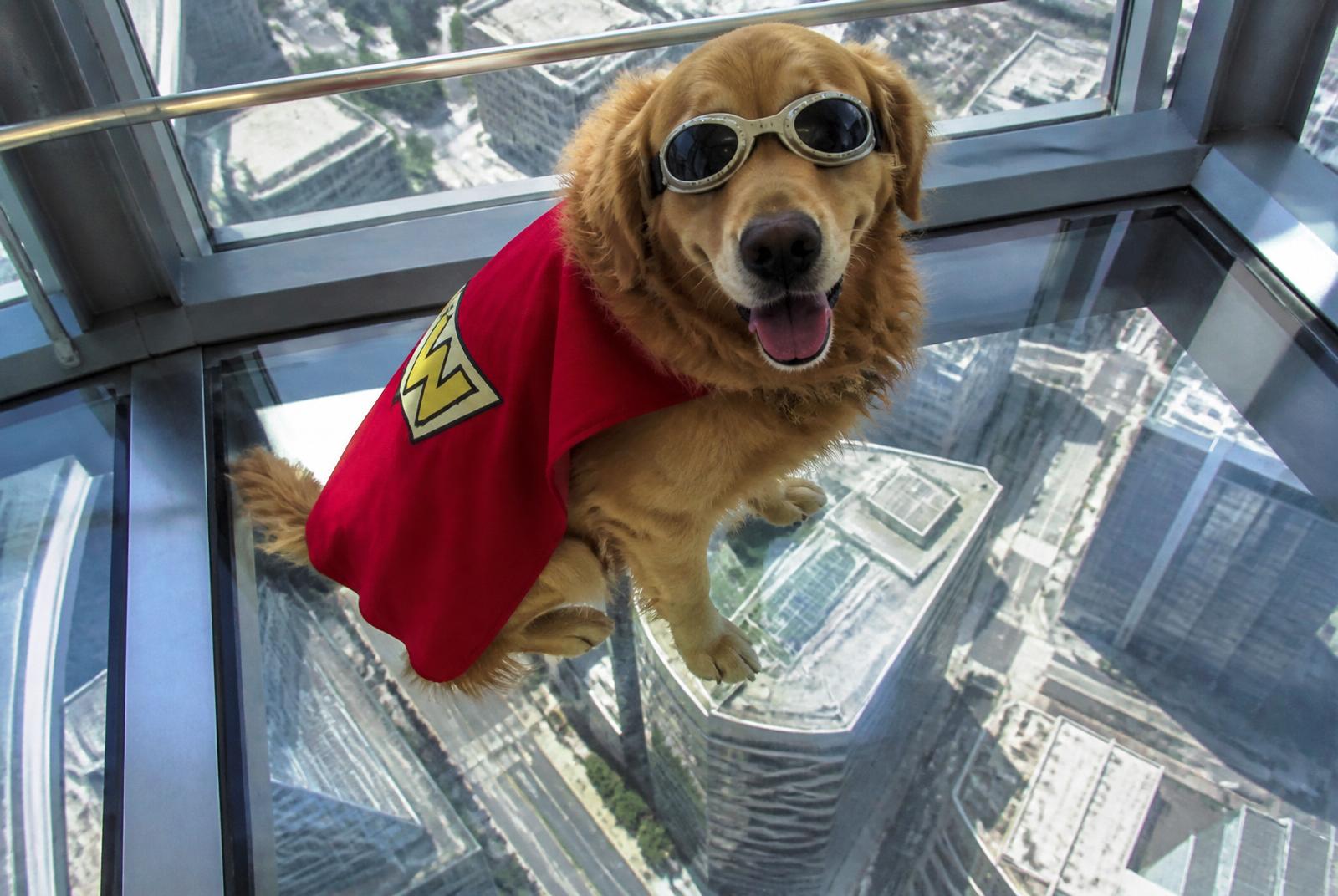
Even a caped super-pup can be brave on the glass floor — the ground is a long way down!

Even a caped super-pup can be brave on the glass floor — the ground is a long way down!

Whimsical composite, made for this story

Chapter 01

The Floor Made of Sky

✦ ✦ ✦

Imagine stepping out of an elevator and walking onto a floor made of glass. You look down past your sneakers and see... nothing. Just air. Far, far below, cars glide along like ladybugs, boats draw white lines across a blue lake, and pigeons — birds that usually fly above you — are flapping along hundreds of metres beneath your feet.

You are standing more than a third of a kilometre above the city of Toronto, Canada, inside one of the tallest structures human beings have ever built: the CN Tower. Some visitors laugh and lie down flat on the glass. Some crawl across it on their hands and knees. Some hug the wall and refuse to step on it at all, even though it is strong enough to hold the weight of 35 moose.

How did this impossible needle of concrete get here? Who dreamed it up, and who was brave enough to build it? Why did a giant helicopter named Olga fly circles around its top? And what does a tower have to do with television, lightning, and a world record that lasted 32 years? Buckle up. We are going all the way to the top.

Chapter 02

How Tall Is Ridiculously Tall?

✦ ✦ ✦

The CN Tower rises 553.3 metres into the sky. Numbers that big are hard to picture, so let's play with them. Imagine stacking basketball hoops one on top of another, hoop upon hoop upon hoop. You would need about 181 of them to reach the tower's tip. Or picture soccer fields tipped up on their ends — you would need five and a half of them, balanced end to end, to match it.

Here is another way to see it: the famous Eiffel Tower in Paris stands 330 metres tall. The CN Tower could look right over its head with more than 200 metres to spare. The tower is so tall that on cloudy days its top vanishes inside the clouds, and visitors on the upper decks gaze down at a fluffy white carpet instead of a city.

It is heavy, too — about 118,000 tonnes, roughly the weight of ten thousand school buses. And now the astonishing part: over its entire height, the tower leans away from perfectly straight by only 29 millimetres. That is shorter than your thumb. Builders call that being 'plumb', and the CN Tower is one of the straightest tall things ever made by human hands.

Chapter 03

The City That Couldn't See Its Shows

✦ ✦ ✦

Our story begins in the late 1960s, with a problem you could see on television. Toronto was growing fast. Gleaming new skyscrapers of steel and glass were shooting up downtown, each one taller than the last. And as they rose, something strange happened in living rooms across the city: TV pictures turned fuzzy and ghostly.

Television and radio signals travel in straight lines from broadcast antennas, and the new towers bounced those signals around like a hall of mirrors. Sometimes people saw two wobbly copies of their favourite show at once — a problem engineers actually call 'ghosting'. The fix was simple to say and enormous to do: build an antenna taller than any skyscraper that would ever rise, so the signals could sail cleanly over every rooftop in the region.

The Canadian National Railway — that's the 'CN' in CN Tower — owned old rail yards beside Lake Ontario and decided to build it there. But the railway's dreamers wanted more than a giant antenna. They wanted a landmark that would show the whole world what Canadian engineers and workers could do. The project would cost 63 million dollars, and nothing freestanding this tall had ever been built. They decided to try anyway.

Chapter 04

The Dreamers and the Wind Machine

✦ ✦ ✦

At first, the plan didn't look like the tower you see today. Early drawings showed three separate concrete towers linked together by bridges. Slowly, the design team — including architect John Andrews and project architect Ned Baldwin, working with an army of engineers — melted the three towers into one graceful shape: a single curving column with three legs that flow together. Seen from high above, its base looks like the letter Y.

But how do you make sure a 553-metre tower won't be toppled by a storm — before you build it? You build a tiny one first. At the University of Western Ontario, in a laboratory run by Alan Davenport, one of the world's greatest experts on wind, scientists placed small models of the tower inside a special wind tunnel: a room-sized machine that blows air like a hurricane.

They watched how pretend storms pushed and twisted the little tower, then adjusted the design until it stood calm and steady. Davenport's wind tunnel went on to test famous skyscrapers all over the planet, but the CN Tower was one of its proudest early jobs. When the tests were finished, the dreamers were finally ready to dig.

Chapter 05

Digging Down Before Climbing Up

✦ ✦ ✦

On February 6, 1973, machines began biting into the ground beside Toronto's old railway lands. Before the tower could go up, it had to go down. Crews dug through soil and then into shale, a grey layered rock, hauling away more than 56,000 tonnes of earth — enough to fill thousands of dump trucks — until they had carved a hole about 15 metres deep. That's roughly as deep as a five-storey building is tall.

Into that hole went the tower's hidden strength: a massive foundation of concrete threaded with thick steel, shaped like a giant letter Y. The three arms of the Y would become the tower's three graceful legs. Workers checked and rechecked every measurement, because a tiny mistake at the bottom becomes a giant mistake half a kilometre up in the sky.

Here is a secret most visitors never learn: when you stand beside the CN Tower today, an enormous slab of engineering lies buried beneath your shoes, doing its quiet job every second of every day. The foundation took only about four months to finish. Then it was time for the tower to do something no structure in Canada had ever done before: grow.

The half-built tower in the 1970s, with a giant crane perched on top where the pod would grow.

The half-built tower in the 1970s, with a giant crane perched on top where the pod would grow.

Robert Taylor, CC BY 2.0, via Wikimedia Commons

Chapter 06

The Doughnut That Climbed the Sky

✦ ✦ ✦

How do you build a concrete column half a kilometre tall? You can't stack blocks like toy bricks. Instead, the builders used a wonderful trick called a slipform. Picture a giant doughnut-shaped mould wrapped around the tower's base. Workers poured wet concrete into the top of the mould. As the concrete below hardened into stone, powerful hydraulic jacks pushed the whole doughnut slowly upward so fresh concrete could be poured in above.

The mould 'slipped' higher day after day, and the tower rose beneath it like toothpaste squeezed from a tube — except this toothpaste hardened into rock, shaped perfectly smooth. The slipform climbed about six metres a day, Monday to Friday. That's two whole storeys every single day. As it rose, the mould was gradually made smaller, which is why the tower gently narrows as it climbs, like a rocket ready for launch.

In all, the builders poured about 40,500 cubic metres of concrete — enough to fill 16 Olympic swimming pools. The concrete was mixed right there at the site and tested constantly, batch after batch, to make sure every scoop was strong. Bit by bit, Toronto watched a grey giant rise above its rooftops.

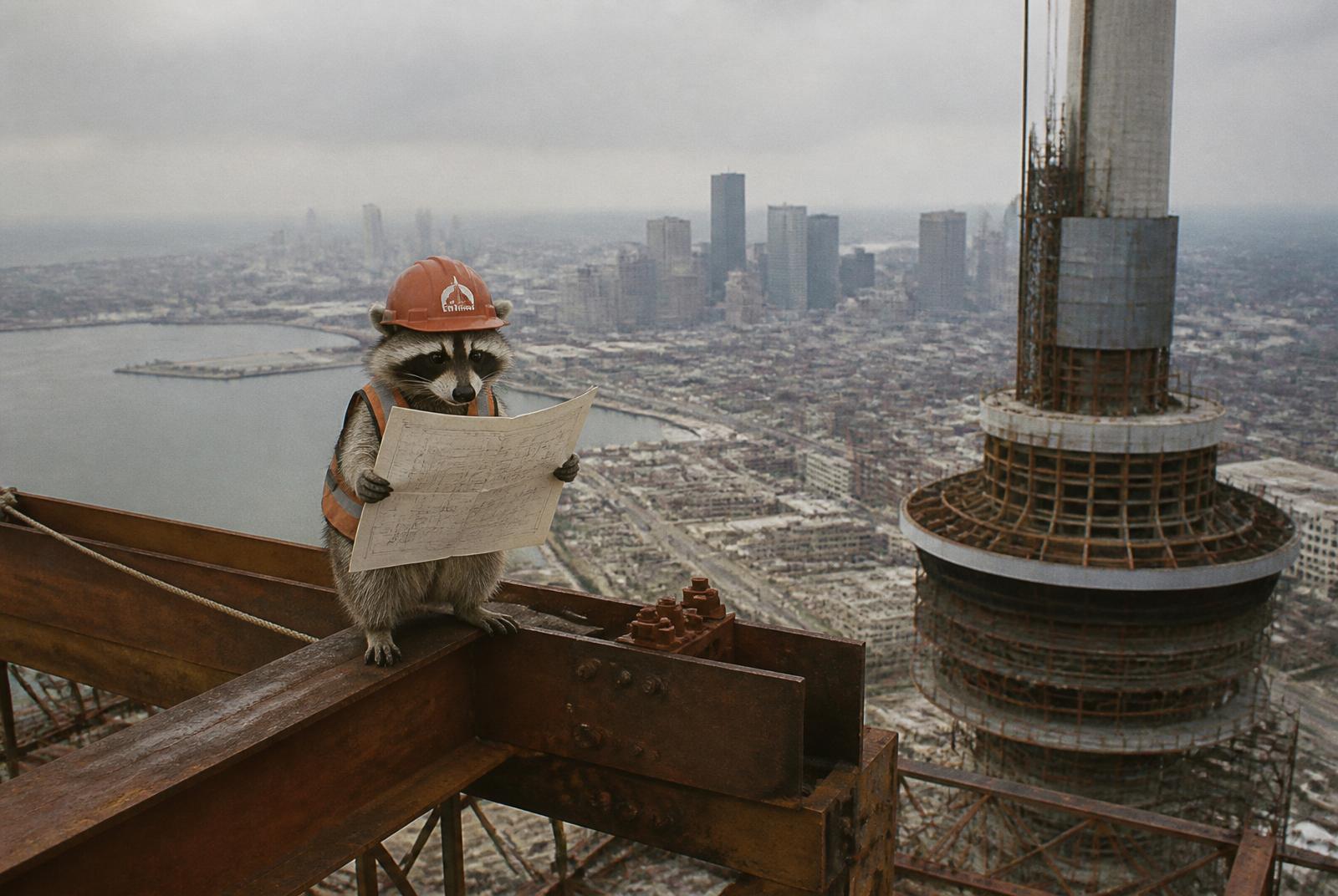
Even a little raccoon foreman would need a hard hat this high up — the builders here were the real heroes.

Even a little raccoon foreman would need a hard hat this high up — the builders here were the real heroes.

Whimsical composite, made for this story

Chapter 07

1,537 Builders in the Clouds

✦ ✦ ✦

It took 1,537 workers about 40 months to raise the CN Tower, working shifts around the clock, five days a week. Think about what that means. They worked through sticky summer heat and through Toronto winters so cold that wind at the top could freeze your face in minutes. They rode open hoists up the outside of the growing tower, higher than any office worker in the country, with the whole city shrinking below them.

There were carpenters and concrete crews, ironworkers and surveyors, crane operators and engineers. The surveyors had one of the most nerve-racking jobs of all: keeping the tower perfectly straight. Using careful instruments and constant measurements, they guided the slipform so precisely that, when everything was finished, the entire 553-metre tower was off from true vertical by just 29 millimetres.

Here's a comparison to chew on: that's like drawing a pencil line as tall as 100 giraffes standing on each other's shoulders — and having your line wobble less than the width of two fingers. The workers were proud of that number, and they still are. Many of them brought their children and grandchildren back years later and said: I helped build this.

Chapter 08

Olga, the Helicopter Hero

✦ ✦ ✦

By early 1975, the concrete had climbed as high as it could go. Now the tower needed its crown: a steel broadcast antenna about 100 metres tall. The original plan was to hoist it up piece by piece with a crane bolted to the summit — a slow job expected to take about six months. Then someone had a braver idea: use a helicopter.

Not just any helicopter. A mighty Sikorsky Skycrane — a flying giant built for lifting huge loads — arrived in Toronto, and everyone came to know her by her nickname: Olga. First, Olga plucked the big construction crane right off the tower's top. Then, flight after flight, she carried the antenna up in 36 sections, each one dangling beneath her on cables while ironworkers waited at the very top, in the wind, to guide each piece into place and bolt it down.

All over the city, people stopped to stare. Schoolchildren watched from playgrounds as the helicopter buzzed around the tower's tip like a dragonfly finishing a flagpole. The whole job took just three and a half weeks instead of six months. On April 2, 1975, Olga lowered the final piece, and the tower was complete.

Chapter 09

The Day the Record Fell

✦ ✦ ✦

As the antenna grew taller that spring, engineers watched their measurements with growing excitement. Far away in Moscow stood the Ostankino Tower, 540 metres tall — the tallest freestanding structure on Earth. 'Freestanding' means it holds itself up with no cables or supports leaning against it, like a person standing without holding a railing.

On March 31, 1975, the CN Tower's rising antenna passed that mark. Toronto — a city many people around the world had barely heard of — was suddenly home to the tallest freestanding structure ever built. When the last piece was bolted on two days later, the final height was 553.3 metres. The record would stand, astonishingly, for more than 32 years. That is longer than most of your teachers have been teaching.

On June 26, 1976, the tower opened its doors to the public for the very first time, and people lined up to rocket skyward in its glass-faced elevators. The grand official opening followed on October 1. The tower had been built to fix fuzzy television, but standing there in the sunshine, brand new and impossibly tall, it had already become something more: a symbol of what daring people can do.

Chapter 10

Fifty-Eight Seconds to the Sky

✦ ✦ ✦

Riding to the top of the CN Tower is an adventure all by itself. The elevators race upward at about 22 kilometres per hour — highway speed for an elevator — and reach the main observation level, 346 metres up, in just 58 seconds. Count it out: by the time you slowly count to sixty, you have risen higher than almost any building in the Americas.

The elevators have glass fronts, so you can watch the city unfold as you climb. The lake stretches wider, the streets turn into a map, and the buildings you thought were huge shrink into toys. Partway up, many riders feel their ears pop, just like in an airplane. That's the air pressure changing as you soar — your body noticing what a serious amount of 'up' you are doing.

Here's a detail lots of visitors miss: in 2008, glass panels were added to the floors of some elevators, so brave riders can stand over them and watch the ground drop away directly beneath their shoes. Some people cheer. Some people very quickly decide to admire the view sideways instead. Either way, in less than a minute, you step out into the sky.

Look down through the famous glass floor and see the ground far, far below your shoes!

Look down through the famous glass floor and see the ground far, far below your shoes!

InSapphoWeTrust, CC BY-SA 2.0, via Wikimedia Commons

Chapter 11

Daring the Glass Floor

✦ ✦ ✦

In 1994, the CN Tower unveiled something no tower had ever offered before: a glass floor, the first of its kind in the world, hanging 342 metres above the ground. Stand on it and there is nothing between your feet and the tiny world below except layers of glass and empty air.

Of course, 'nothing but glass' is not quite fair to the glass. The floor is built like a super-sandwich about 6.4 centimetres thick: a thick pane of laminated glass, then a sealed air space, then another strong pane below. It is engineered to withstand enormous pressure — the tower's own fun fact says it could hold the weight of 35 moose standing on it at once. It is actually several times stronger than the ordinary solid floors in a shopping centre.

And yet! Knowing all that and feeling all that are two different things. Watch the glass floor for ten minutes and you will see human courage in action: kids starfish flat on their bellies and grin down at the city, grown adults inch across on tiptoe, and every so often someone's dad stands with his back pressed firmly against the wall, insisting he is perfectly comfortable right where he is.

From the observation deck, Toronto's buildings look like tiny toys beside the big blue lake.

From the observation deck, Toronto's buildings look like tiny toys beside the big blue lake.

Antony-22, CC BY-SA 4.0, via Wikimedia Commons

Chapter 12

Seeing Forever from the SkyPod

✦ ✦ ✦

High above the main deck sits a smaller, quieter room called the SkyPod, perched 447 metres above the ground — one of the highest observation platforms on the planet. A second elevator carries you up through the narrow neck of the tower, and when the doors open, the view stops people mid-sentence.

On a clear day you can see for well over 100 kilometres. Look south, across the blue sweep of Lake Ontario, and you are looking toward the United States — the far shore is New York State. Look southwest and you can sometimes spot the rising mist of Niagara Falls, one of the world's most famous waterfalls, hovering like a tiny white feather on the horizon. Look down and ferries crawl to the Toronto Islands like water beetles.

Here's a secret most visitors never think about: late in the day, the tower draws with its own shadow. As the sun sinks, the CN Tower's shadow stretches out across the streets and rooftops for kilometres, a giant sundial laid over the whole city. People far below walk through the tower's shadow without ever noticing. From the SkyPod, you can watch it reach across Toronto like the hand of a clock.

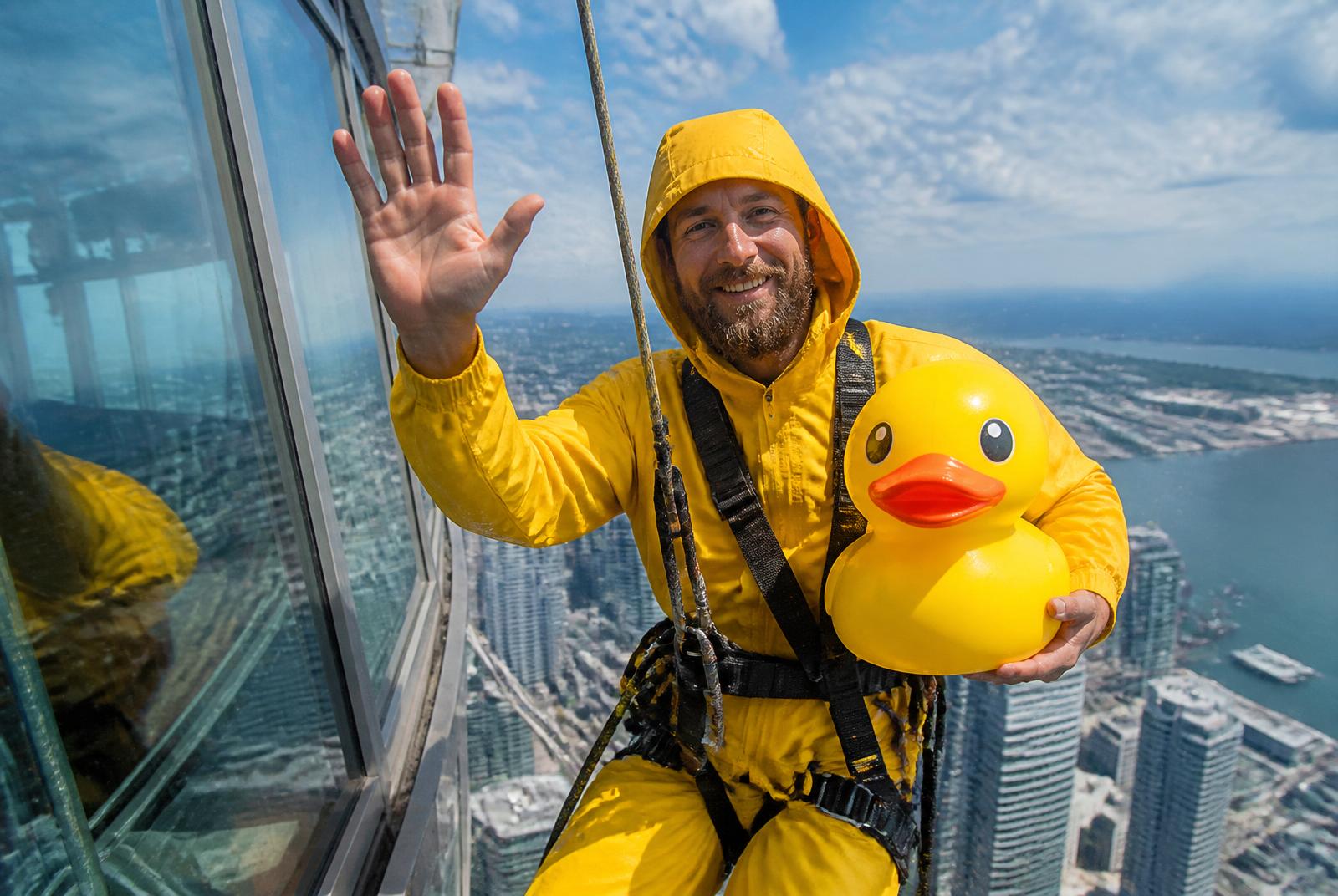
A brave window washer waves hello from way, way up on the tower — with a rubber duck for company!

A brave window washer waves hello from way, way up on the tower — with a rubber duck for company!

Whimsical composite, made for this story

Chapter 13

Walking on the Edge of the Sky

✦ ✦ ✦

For most of its life, the CN Tower asked visitors to stay safely inside. Then, on August 1, 2011, it opened EdgeWalk — and everything changed. EdgeWalk lets visitors walk outside, in the open air, around a ledge that circles the roof of the tower's main pod, 356 metres above the ground. The ledge is only about a metre and a half wide. There is no handrail.

Before you panic: every walker wears a strong harness clipped to an overhead safety rail, checked and double-checked by trained guides. Small groups shuffle out into the wind, hearts hammering, and then the guides invite them to do something that sounds impossible — lean out over the edge of the tower, arms spread wide, held by the harness, with all of Toronto glittering below their toes.

People scream. People laugh. Quite a few people do both at once. EdgeWalk earned a Guinness World Record as the highest external walk on a building, and grandparents, teachers, and nervous first-timers have all conquered it. Ask anyone who has done it and they will tell you the same thing: the scariest step is the first one, and the feeling afterwards is pure flying.

Zap! Lightning strikes the tower's tip, and the tower calmly guides it safely into the ground.

Zap! Lightning strikes the tower's tip, and the tower calmly guides it safely into the ground.

Raul Heinrich, CC BY-SA 3.0, via Wikimedia Commons

Chapter 14

The Tower That Tames Lightning

✦ ✦ ✦

Here is a stormy secret: the CN Tower gets struck by lightning about 75 times every year. Seventy-five! During a good summer thunderstorm, bolts may hit it again and again, and photographers race to their windows hoping to catch the perfect picture of white fire touching the tower's tip.

So why doesn't the tower get hurt? Because it was built to be struck. Long copper strips run down the tower and connect to heavy grounding rods buried deep in the earth. When lightning hits, the electricity doesn't smash and burn its way through the structure — it glides smoothly down the copper, like a slide at a playground, and disappears harmlessly into the ground. Visitors inside usually don't notice a thing.

And here's the part most people never realize: by standing so tall and catching the lightning first, the tower acts like a giant protective umbrella for its neighbourhood. Bolts that might have zapped smaller buildings nearby are drawn to the tower's tip and safely drained away. The tower doesn't just survive storms — it quietly guards the city during them. The next time you see a photo of lightning striking the CN Tower, don't feel sorry for it. That's the tower doing one of its jobs.

Chapter 15

Why the Tower Dances

✦ ✦ ✦

Would it surprise you to learn that the CN Tower sways? It's true. In very strong winds, the tip of the antenna can lean about a metre from centre, swinging gently back and forth far above the highest visitor. Some people hear that and gasp — but engineers hear it and smile, because the swaying was planned from the very beginning.

Think of a tree in a storm. A stiff, dried-out branch snaps in a strong gust, but a living branch bends, springs back, and survives. Buildings work the same way. A structure that refuses to move fights the wind with all its strength — and the wind, given enough time, is stronger. A structure that bends just a little lets the wind's energy pass through it like a wave.

Remember Alan Davenport's wind tunnel, where model towers faced pretend hurricanes before the real tower was ever built? This is what all that testing was for. The tower's shape, its taper, its deep foundation and its hidden steel were all tuned so it could ride out storms far fiercer than any Toronto has ever recorded. Visitors at the top almost never feel the motion. The tower dances — but so smoothly that nobody notices.

Chapter 16

1,776 Steps of Courage

✦ ✦ ✦

Hidden inside the CN Tower is something most visitors never see: a staircase. Not a grand marble one — a plain metal staircase that zigzags up and up and up. There are 1,776 steps to the main deck, and 2,579 if you keep going all the way to the SkyPod level. It is one of the tallest staircases anywhere on Earth.

Most days it is used for safety and maintenance. But on special days each year, the stairs fill with puffing, determined people, because the tower hosts famous charity stair climbs. Thousands of climbers — kids, grandparents, firefighters sometimes wearing their heavy gear — haul themselves up every single step to raise money for good causes like the United Way and the World Wildlife Fund. Together they have raised millions of dollars, one step at a time.

An average climber takes about half an hour, with burning legs and a giant grin at the top. The all-time record is almost unbelievable: in 1989, a climber named Brendan Keenoy ran up the 1,776 steps in just 7 minutes and 52 seconds. That's nearly four steps every second, the whole way up. Go ahead — try running up your stairs at home like that. Now imagine 100 more floors.

Chapter 17

The Restaurant That Spins in the Sky

✦ ✦ ✦

Imagine eating dinner 351 metres in the air while the entire city slowly glides past your table. At the CN Tower's revolving restaurant, called 360, that's exactly what happens. The ring of floor beside the windows turns gently — one full circle every 72 minutes — so without ever leaving your seat, you watch the lake, the islands, the downtown towers, and the sunset parade past like the world's biggest movie screen.

The spinning is so slow and smooth that many diners don't notice it at first. Then they look up from their plates and realize the view has completely changed. A trick regulars know: leave something small on the windowsill, which does not rotate, and watch your table drift away from it. By dessert, you have travelled all the way around and your marker comes gliding back to greet you.

And here is a record almost nobody expects: this restaurant in the clouds holds a Guinness World Record for the world's highest wine cellar, at 351 metres. It is a real cellar with racks and a wooden door — except instead of being underground like every normal cellar in history, it floats higher than the rooftops of almost every skyscraper in the country.

At night, 1,330 LED lights paint the tower in glowing colours like a giant light show.

At night, 1,330 LED lights paint the tower in glowing colours like a giant light show.

Mrtea, CC BY 2.5, via Wikimedia Commons

Chapter 18

Secrets Hiding in Plain Sight

✦ ✦ ✦

Look closely at the CN Tower and you'll start spotting secrets. See that white ring, like a doughnut, wrapped around the tower below the main pod? Most people assume it's decoration. It isn't. It's a radome — a weatherproof cover protecting microwave receivers, part of the tower's communication equipment. The tower never stopped doing its first job: to this day, its antenna beams television and radio signals across the entire region for more than a dozen stations. Every time someone in Toronto turns on an old-fashioned antenna TV, the CN Tower is talking to them.

At night, the tower becomes a light show. In 2007 it was fitted with 1,330 LED lights that can paint it any colour: red and white for Canada Day, spooky orange for Halloween, team colours when Toronto's clubs are playing. The lights are programmed like a giant vertical screen.

But here's the kindest secret of all. Twice a year, during spring and fall bird migration seasons, the tower dims its dazzling lights. Millions of songbirds fly over Toronto at night, navigating by the stars, and bright lights can confuse them. So the giant quietly goes dark, letting the tiny travellers pass safely overhead.

Chapter 19

The City at the Tower's Feet

✦ ✦ ✦

The tower's home city has a story of its own. The name Toronto likely comes from the Mohawk word 'tkaronto', describing a place where trees stand in the water — a name from the Indigenous peoples who knew and travelled this land for thousands of years before any tower or railway existed.

The CN Tower rose on old railway lands, where freight trains once rumbled and clanged day and night. Today that same ground is one of the liveliest corners of Canada. Right beside the tower stands the Rogers Centre stadium, which opened in 1989 with a superpower no stadium had ever had before: the world's first fully retractable motorized roof. On sunny days the roof rolls open like a giant unfolding shell so baseball fans can watch the Toronto Blue Jays under open sky; when rain comes, it closes right over their heads.

At the tower's feet sits Ripley's Aquarium of Canada, opened in 2013, where visitors ride a moving walkway through an underwater tunnel while sharks and sawfish cruise silently overhead. Think about that: in one city block, you can stand higher than the clouds and walk beneath the sharks. Not bad for an old train yard.

Chapter 20

The Million-Life Medicine Next Door

✦ ✦ ✦

From the tower's deck, look north past downtown and you can spot the University of Toronto. In the summer of 1921, in a hot, cramped laboratory there, a young doctor named Frederick Banting and a student assistant named Charles Best chased a desperate idea. At that time, a disease called diabetes was a death sentence, especially for children, because their bodies couldn't control the sugar in their blood.

Working with Professor J.J.R. Macleod and a scientist named James Collip, Banting and Best discovered how to extract insulin, the missing helper that people with diabetes need. In January 1922, a 14-year-old Toronto boy named Leonard Thompson, terribly ill in hospital, became the first patient saved by it. Children who had been dying woke up, sat up, and got better. Doctors called it a miracle. It was really science, courage, and stubbornness.

Here's the part that still amazes people: the discoverers sold the patent for insulin to the university for just one dollar. They believed a medicine that saved lives should belong to the world, not make them rich. Insulin has since saved millions upon millions of people. One of humanity's greatest gifts was invented a short walk from the tower's shadow.

Chapter 21

The Biggest Movie Screens on Earth

✦ ✦ ✦

Have you ever watched a movie on an IMAX screen so enormous it fills your whole vision, with sound that rumbles in your chest? Here's something most people don't know: IMAX is a Canadian invention, born right here.

In 1967, at a giant world's fair called Expo 67 in Montreal, Canadian filmmakers experimented with huge multi-screen movies, and audiences went wild. Three of them — Graeme Ferguson, Roman Kroitor, and Robert Kerr — teamed up with engineer William Shaw to invent something better: a new kind of camera and projector using extra-large film, so a single image could be blown up to the size of a building and stay crystal clear. They called their company IMAX.

In 1971, the world's very first permanent IMAX theatre opened at Ontario Place in Toronto — a futuristic dome on the lakeshore called the Cinesphere, which you can spot from the CN Tower's observation deck. From that dome, the idea spread across the whole planet. Today, when you watch a space documentary or a superhero blockbuster on a towering IMAX screen anywhere in the world — from Tokyo to Paris to your nearest big cinema — you are enjoying an invention that grew up in the tower's home town.

Chapter 22

A City of Bright Ideas

✦ ✦ ✦

Toronto's inventions don't stop at insulin and IMAX. In 1938, two young students at the University of Toronto, James Hillier and Albert Prebus, built the first practical electron microscope in North America. Instead of using light, it used beams of tiny particles called electrons to magnify things thousands of times more powerfully than ordinary microscopes — letting scientists finally see viruses and the secret machinery inside cells.

In 1940, a Toronto inventor named Norman Breakey came up with something humbler but wonderfully useful: the paint roller. Before Breakey, painting a wall meant hours of slow brushwork. After him, anyone could roll on smooth paint in minutes. Look in almost any garage on Earth and you'll find his idea resting in a tray.

And one more, for comic fans: Superman was co-created by Joe Shuster, an artist born in Toronto who once delivered newspapers for the Toronto Daily Star. When Shuster and writer Jerry Siegel invented Superman's city newspaper, they first called it the Daily Star — a wink at the paper from Joe's childhood — before it became the famous Daily Planet. So a little bit of Toronto is hiding inside the world's most famous superhero. Bright ideas, it seems, grow well here.

Chapter 23

Myths vs. Facts

✦ ✦ ✦

Time to bust some tower myths. Myth one: 'The CN Tower was the world's tallest building.' Not quite! Experts who measure these things say a 'building' needs floors where people live and work most of the way up. The CN Tower is mostly a slim concrete column, so it's officially a tower — and for 32 years it was the world's tallest freestanding structure of any kind, which is arguably even cooler.

Myth two: 'If the tower sways, something is wrong.' The opposite is true. The sway is the design working perfectly, letting wind energy pass through instead of fighting it.

Myth three: 'The glass floor might break if too many people stand on it.' The glass floor is a thick, layered sandwich engineered to hold far more weight than any crowd could ever put on it — remember the 35 moose. The wobbliest thing on that floor is people's knees.

Myth four: 'It was built as a tourist attraction.' Nope — it was built to fix fuzzy television! The observation decks were almost a bonus. Millions of visitors a year now enjoy a view that exists because 1970s TV signals kept bouncing off skyscrapers. Sometimes the best wonders begin as solutions to ordinary problems.

Chapter 24

A Wonder Among Wonders

✦ ✦ ✦

In 1995, the American Society of Civil Engineers named the CN Tower one of the Seven Wonders of the Modern World, alongside marvels like the Golden Gate Bridge, the Panama Canal, and the tunnel beneath the English Channel. Engineers around the world agreed: this tower was one of humanity's most extraordinary feats.

Then, on September 12, 2007, far away in the desert city of Dubai, a rising skyscraper called the Burj Khalifa finally grew taller, ending the CN Tower's 32-year reign as the world's tallest freestanding structure. Was Toronto sad? A little. But records in building, like records in running, are meant to inspire the next dreamer — and the CN Tower remains the tallest freestanding structure in the entire Western Hemisphere to this day.

Here's a final surprise: the tower doesn't belong to a billionaire or a private company. It is owned by a public company on behalf of the Government of Canada — which means, in a real way, it belongs to Canadians themselves. Every year, well over a million visitors from all over the planet ride its elevators, dare its glass floor, and lean out over its edge. Fifty years on, the tower still broadcasts, still glows, and still amazes.

Chapter 25

Your Own Tower

✦ ✦ ✦

So here you are, back at the bottom, neck craned, looking up at 553.3 metres of concrete, steel, and stubborn imagination. Remember how it all started: not with a wish to break records, but with fuzzy television and a question — what if we built something taller than the problem?

Remember the wind scientists testing tiny towers in a hurricane machine. Remember the 1,537 builders working through frozen winters, keeping half a kilometre of concrete straight to within 29 millimetres. Remember Olga the helicopter, stitching an antenna into the sky in three and a half weeks. Remember the city below, where two determined researchers turned a one-dollar patent into insulin for the world, and where movie dreamers built screens as big as buildings.

None of those people knew for certain they would succeed. They measured, tested, practised, failed a little, fixed things, and tried again — the same tools you already own. Somewhere inside you is a tower of your own: a machine, a medicine, a story, a bridge, a question nobody has answered yet. It probably looks impossible from the ground. Most great things do. Start digging your foundation anyway. And one day, someone will stand at the bottom of what you built, look up, and wonder how anyone ever dared.

✦ ✦ ✦
The End

And that is the story of The CN Tower

The world is full of incredible things, and you have just discovered another one. Keep wondering. Keep asking. There is always more to find.

Choose the Next Wonder →